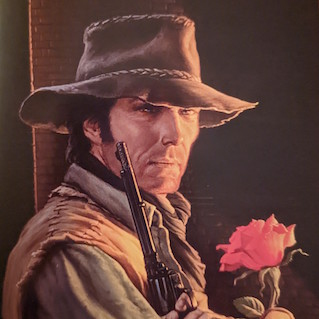
 Goodreads: Describe the book you’re currently reading in three words!
Jarrod: Author reinserts himself.
If I’m going to review books V and VI then I might as well close it out with number VII—more Roman numerals, please! Do I then follow the author’s lead and start over with The Gunslinger next? “Stephen King fled through another rushed ending, and the blog-man followed.” Spoiler alert!
The eponymous The Dark Tower is an improvement over Song of Susannah but I’m not sure by how much—this is my second time through the series (and my third reading of The Gunslinger, The Drawing of the Three and The Waste Lands) and the book isn’t as strong a finish as I remembered. Gone are the multivariate sub-goals—killing off several main characters will tighten any plot—and we eventually settle on a single path that’s been there since the beginning. In many ways, it’s one of only three of the seven books—with The Gunslinger and The Waste Lands—that really moves in a straight line toward, you know, the Dark Tower. The Drawing of the Three is still my favorite but, when you think about it, all Roland does there is lose some fingers and gain a couple of friends after heading west and turning left to go… north? OK. The Waste Lands picks up from there and doubles back on itself to rescue Jake (again) and Oy (love that little guy!) but they’re newly motivated and moving forward along the path of the beam. River Crossing, Lud, Blaine over the Waste Lands, they’re all points on the same heading, followed by Topeka and Emerald City during the (limited) chronological portions of Wizard and Glass. Wolves of the Calla, as I wrote last year, is “almost conventional and self-contained”—it, more than the others, improved in my second read-through.
Here’s the part where I review other books before getting to the one I purport to review.
Wolves of the Calla is pretty great. Calla Bryn Sturgis is a mere stop along the way like Tull or Lud but gets seven hundred pages all to itself—world-building, exposition and catching up with Father Callahan account for a lot of this, because King had a whole bunch of new ideas and only three books to make it cohere with the four before it (even if it meant rewriting the first), but it’s a compelling place to spend time. Dead center in the success is one of King’s most fully realized baddies: Andy the Messenger Robot (Many Other Functions). The Tick-Tock Man, Mordred Deschain, the Crimson King and our old friend the Walkin’ Dude (at least his Dark Tower iteration) would kill for his character arc. Nothing about that stainless-steel bastard is an afterthought and I’m willing to bet it’s because he didn’t survive beyond the fifth book—there was no time for King to lose interest the way he did with those others. More to come on that. But hey, who doesn’t want to read more about this guy? Take it, Wikipedia, and mind my heavy copyedit!
Andy the Messenger Robot (Many Other Functions)
Andy, described as an amicable humanoid robot reminiscent of C-3PO, lived in the Calla for thousands of years and was obsessed with telling people their horoscopes. He was loved by all the children in the Calla and betrayed this closeness by feeding information about them to the Wolves. Jake uncovered Andy’s sinister nature and Eddie shot his eyes out before ordering him to shut down. Andy was buried underneath a pile of manure in an outhouse.
Wow! Mysterious origins, self-interested treachery, discovery and a satisfying end—no retconned loyalties, no recharacterization, no convenient disappearance, no vague “Is he really dead?” letdown. And manure! Ain’t coming back from that, unless King gives us another shoddy round of inter-volume The Wind Through the Keyhole filler called, I don’t know, Curse My Metal Body; or, Shit Don’t Rust.
Jump ahead to The Dark Tower. We meet Mordred first as a helpless infant and soon after as a moody, starving teenager. Oh good! It’s a shape-shifting Harold Lauder! Hints at Susannah’s pregnancy and her “chap’s” awfulness are new (I think) to the later three books but it and the insertion of the goddamn author take absolute hold in the boring Song of Susannah. For all that’s foretold of Mordred’s destiny and all that’s revealed after his delivery at the Dixie Pig… what the hell does everyone so revere? He can’t even feed himself! Then he disappears from large chunks of the narrative before a ho-hum death in a handful of paragraphs. “If his fate is fulfilled, he will both kill Roland and topple the Dark Tower itself.” Zero for two! This is a source of dread, or even tension??
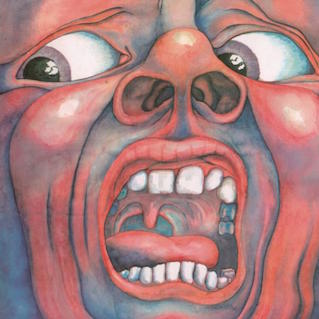 Not to be outdone is the Crimson King. “I run to grasp divining signs to satisfy the hoax.” You got that right! The former “Beast” was retconned into revisions of the earlier books before (again, I think) being formalized as the main antagonist in Wizard and Glass. Sure. We learn little about him except for the fact that “his goal is to topple the Dark Tower, which serves as the linchpin of time and space, destroying the multitude of universes which revolve around it so that he can rule in the primordial chaos which follows.” Who’s left in this primordial chaos to rule? Never mind. He’s clearly gone mad and his followers are still all “Great!” Sounds familiar.
If Mordred’s regrettable conception and sudden demise—sudden in the sense that, though his existence spans seven hundred pages, he is only featured or even referred to for maybe ten percent of it—then the Crimson King’s denouement is even worse. Talk about creative remorse! The author (re)introduces another character from another one of his books in Patrick Danville because someone needs to be able to magically erase shit. This is handled with far less grace than Father Callahan’s return but, truthfully, that might be because the twice-enjoyed ’Salem’s Lot is a top-fiver for me. Whether or not I’ve read Insomnia (I haven’t), volume seven out of seven is a strange time to add people—people responsible for the humiliating near-death of “the Lord of Spiders.” At least give Jake the job.
The tightness of the first four or five books is long gone. At this late stage, besides Patrick, Ted Brautigan is lifted from Hearts in Atlantis while Dinky Earnshaw checks in from the title story of Everything’s Eventual, which I did read and don’t remember. (Also from this collection: “The Little Sisters of Eluria,” a sort of Dark Tower, Vol. 0. Moving on.) Sheemie Ruiz returns, too, from Wizard and Glass, and that I do kind of like, but then he dies offscreen of an infection or something. Oh! And John Cullum makes an encore appearance from Song of Susannah because, I don’t know, King ran out of non-canon expats and wanted to keep the local Maine flavor going. King gets bored of him hundreds of pages late and replaces him with Irene Tassenbaum, who serves her horny purpose and exits. Who are these people? Does the multi-thousand-page tale stall without them? We’re so close to the Tower! It’s right over there!
Adding and subtracting pieces is much to blame for the lack of overall cohesion but I challenge anyone, never mind a forty-something blog-maker with no readers, to wrangle anything a tenth as long over fifteen-plus years, and longer if you include The Gunslinger. Understood, and cheers to the man. Across the full series, then, the larger consistent problem I have is the way the books themselves are carved up. Beginnings and endings matter, people! Observe redrafting gone mad as I shuffle entire sections and improve upon the saga:
I. The Gunslinger
Forget the “revised and expanded” edition, just correct Farson/Taunton and any other minor inconsistencies. Really solid—Roland and Mid-World are well defined for such a short book, and those slow mutants are terrifying.
II. The Drawing of the Three
Unchanged. Perfect.
III. The Waste Lands
As I wrote before, this is a terrific adventure with significant developments, high stakes and memorable characters… and then it just stops aboard Blaine. What is that? Reclaim its ending from the Wizard and Glass prologue and append it to the proper book—who cares if it’s a hundred pages longer, it’s Stephen King, people will read it.
IV. Wizard and Glass
The fourth book becomes a total flashback story, opening on Rhea of the Cöos and closing, in mourning, with Roland, Cuthbert and Alain. Gone is its epilogue because, hey, it turns out the Tick-Tock Man did die in Lud! We never visit Emerald City and Marten/Walter/the Ageless Stranger/the Walkin’ Dude just sort of goes away—he amounts to nothing anyway so let’s phase him out early.
V. Wolves of the Calla
We revisit the main storyline and Wolves is left intact. Salvageable scraps from the Wizard epilogue—I’m thinking of the bit where stuff is left for them in the road, perhaps by Richard Patrick Sayre in this retelling—can slot in somewhere between Topeka and Calla Bryn Sturgis, since that will need to be fleshed out post-Waste Lands. This would be my second-favorite of the series if it weren’t for the meta nature of the goddamn author inserting himself. Eighty-six that nonsense.
[Here’s where I really switch things up. It’s far easier to destroy than to create.]
VI. Song of Susannah
Stephen King, you can have the Crimson King or you can have the Little Red King. You must choose, brother, you must choose! Who should it be? I say Mordred dies in childbirth along with Mia, that way we lose a lot of the book’s melodrama and misspent buildup. In fact…
VI. Song of Susannah
VI. The Crimson King
Book six is renamed and reimagined because we know nothing about our eponymous villain and that history lesson is overdue. Right, so I’ve created a huge problem. I’m demanding hundreds of pages—hundreds—devoted to “the title character.” We as readers have earned this in order to avoid not giving shit about a pair of disembodied eyes as written… disembodied, petulant, benign eyes, Simpsons eyes, with blinking white circles and black pupils. Come on.
Aye, the Crimson King. What’s his damage? This character needs depth to go along with Michael Whelan’s badass finale illustration that works perfectly as this revised volume’s cover—I’ll even lay out the type! So, yeah, hundreds of pages from nothing. I don’t know where it goes but it has to be better than getting rubbed out by some tongue-less rando from another book. Onward.
The first third of the new book follows our heroes into New York City (the tale of Jake, Callahan and Oy is untouched), rural Maine (Roland and Eddie’s trip is combined in a way with Roland, Jake and Oy’s from The Dark Tower, sans Jake—who survives because the Bryan Smith accident goes bye-bye—and Oy) and Susannah’s mind. John Cullum stars as a minor character with fifteen minutes of fame and no Dark Tower encore. Susannah Dean stars occasionally as Detta Walker. Stephen King does not star as Stephen King. Where appropriate—my man’s a professional writer with… billions?… of books sold so I trust him to solve the problem—the Crimson King is talked about by the ka-tet and the low men like “Holy shit, how about this Crimson King! I heard this one time he…” etc. As readers we’re all “Whoa! Roland’s fucked!”
The middle third is a straight-up flashback where we learn everything we need to know about the early days of the Crimson King. Does he enjoy travel? Does he think greatest-hit compilations should be disqualified from “favorite album” lists? Does he personally shove as many teeth into those fucking vampires’ mouths as he can hold? Seriously though: how old is he? How did he develop a following and align himself against the Eld with the likes of John Farson, Pimli Prentiss and Walter “Walkin’ Dude” Padick? What is his relationship with the Dark Tower and why does he work to destroy it? Is he a sorcerer, a devil, a terrorist or just a power-hungry bad guy, and why is he so angry and insane? “The ultimate in evil… he has opposed Roland of Gilead from the beginning.” Why? Envy? Spite? I want to believe!
[Insert the Crimson King’s new backstory.]
Oh, now I get it. Pow! This Crimson King is a mean motherfucker who’s going to annihilate existence and slaughter these characters I’ve loved since middle school! Yes, the final third sets up the final book as The Crimson King ends with the assault on the Dixie Pig and (sadly) the pere’s death—RIP Father Callahan. I like the way this sequence kicks off The Dark Tower but that book feels so rushed and slapped together that a weird rhythm emerges with both the Dixie Pig and Algul Siento as huge set-piece climaxes. Separating them will help. Killing Mordred will help even more. Good riddance.
VII. The Dark Tower
It sounds like I hated this book. I didn’t, and if you take away the retread characters, the awkward pacing, the weak-ass supervillains and the goddamn author inserting himself then you’re left with a lot of five-star material that rewards readers of the three original books. King’s skills as a storyteller are remarkable enough to overcome sprawl and buried here is an exciting, weird motherfucking masterpiece. So what are we left with?
Chapter one has to be “The Master of My Blue Heaven.” We wrap our heads around Algul Siento—the ka-tet’s next stop on the way to the Tower needs room to breathe—and overhear lots more “Fuckin’ hell!” context about the Crimson King. We also meet Pimli Prentiss and Finli o’ Tego, and though the latter was mentioned in Wolves, both are new characters. I don’t give a shit. Hear me out.
Pimli and Finli are Boss Hogg and Rosco P. Coltrane if The Dukes of Hazzard were less historical Republican assumptions—celebrating serial crime in the interest of profit; disguising rural white poverty as sought-after American freedom; shunting Blacks and women aside as token non-factors—and more about everyday Republican aspirations—abducting and despoiling underprivileged children; forcing mothers to carry doomed pregnancies to term; arming actual monsters in the service of madness and depravity. I love that King lays these creeps so bare—“[Finli] also enjoys eating pus, offered by Prentiss as he breaks the pimples that erupt on his face”—and, as with Andy, I’m glad to know them and glad they died badly. Good writing is knowing when to quit. Good writing is also looking forward to The Dukes of End-World reruns after school.
From here I have to move shit around to hold it together. Following “The Door Into Thunderclap,” “The Thing Under the Castle,” starring one of Lovecraft’s shoggoths, carries the reunited ka-tet to Algul Siento, not from it. Susannah, whom I lost interest in a long time ago, succumbs to her childbirth trauma and falls behind, consumed by the monster. RIP Susannah. The only thing her character is capable of by this point is making us feel sad along with Eddie, and we will miss him a lot more later on. Now we don’t have to pretend that springing a stubborn cold sore is an important step toward defeating the Crimson King. That dude’s fucking crazy! Anyway, a pattern emerges: Roland’s allies (excepting Oy) die off LIFO-style.
I know, a lot of the stuff between the Dixie Pig and Algul Siento will have to be rewritten without the author-inserting-himself bullshit. Not my problem.
“The Attack on Algul Siento” follows as is, minus Susannah. RIP Eddie. Drag.
After that: no return trips to Maine and New York, no inserted-author-almost-dying bullshit, only forward motion—we are cruising without Mordred’s sad-sack coming of age! Jake is still with us. Roland is prepared to lose him (again). And Irene Tassenbaum, a cool character without a place here, is reserved for her own book.
The author plows ahead with what might be a bad idea and turns it into something bonkers and wonderful. The whole Dandelo sequence makes no sense at all—did Roland and Susannah really suspect nothing?? How many witches, wizards and demons does one need to encounter before skepticism kicks in? For crying out loud, they knew to look out for someone or something dangerous named Dandelo! Sigh. Again, though, I don’t give a shit. Susannah is no longer with us so Jake and his childhood naiveté take her place until he’s tragically lost to death-by-laughter. RIP Jake. Patrick may or may not exist in my rewrite, who knows, but if he does he’s wished well and seen off at the end of the episode. The ka-tet, down to two, continues along the path of the beam, inconsolable Oy and sociopathic Roland. (Side note: release “Joe Collins of Odd’s Lane” and “Patrick Danville” in back-to-back issues of, I don’t know, The New Yorker as a teaser to the seventh book. Eventually combine them into a high-end paperback edition with a shitload of Whelan illustrations so we can fall in love with Dandelo and Lippy all over again.)
Oy perishes next and it sucks. The penultimate battle goes down about the same except that Mordred died awhile ago—hooray!—so maybe the Walkin’ Dude or a manifestation of the Crimson King himself takes his place. RIP Oy. 😭
“Roland continues on to his ultimate goal and reaches the Tower, only to find it occupied by the Crimson King. They remain in a stalemate for a few hours.” Wrong! It’s the moment we’ve all been waiting for and it’s settled in sixty pages. Sixty! When you’re reading an epic story spanning thousands of pages (and well over a hundred dollars), it’s natural to have doubts about Roland’s journey wrapping up one way or another in a few dozen. I don’t need everything tucked in with military corners because nothing ever is, but I do want to be satisfied that the author didn’t simply run out of gas. And I certainly don’t want to be patronized for, you know, wanting to read the whole book. As “rewritten,” this confrontation will now last years—centuries!—and a full third of the book. The two slug it out like Rocky II and Roland emerges victorious to enter the Tower and confront a lifetime of human shortcoming.
“There is no such thing as a happy ending.” Right on. Self-awareness was never Roland’s strong suit and his impatience leads him, yes, back to the Mohaine Desert—what can I say, it kind of works. Most readers hated the looped non-ending but I don’t, though I wonder why Roland isn’t sent back to Jericho Hill or even further so we can witness the Horn of Eld’s rescue from where it fell with Cuthbert (RIP). What felt like a minor moment in the Wolves of the Calla flashback ballooned into a significant clerical/transcendental error, and for all the Horn’s later significance it gets two hundred words in the Dark Tower Wiki. Consider the source, sure, but The Gunslinger’s Sylvia Pittston gets the same. Whatever. Roland let Susannah roll off with one of the sandalwood irons anyway. But what to make of Patrick hearing “the sound of a horn” that “simultaneously chilled [his] blood and exalted him” before Roland entered the Tower? A horn?? I’m confused.
This can only be the ending King wanted to give us except for the fact that, you know, Roland never had the fucking Horn; the ending after which King would have written “Don’t go no further, there is no such thing as a happy ending,” and we would have replied “Dude, that’s the last page.” It’s a weird moment that feels like legitimate oversight given what’s to follow in the guilt-laden coda when Roland misspells “MacGuffin” at the Can’-Ka No Rey National Spelling Bee. Carry on. There are other worlds than these.
The man in black fled across the desert, and the gunslinger followed.
It has a nice ring to it and, oddly, satisfies as closure. Who am I to criticize? I can’t even review a book without rewriting it and/or reviewing entirely different books, for crying out loud.
⭐⭐⭐⭐
 More Cream Please
cool post!
LikeLiked by 1 person