 “We have a Switch??” Nothing gets past a nine-year-old (at the time) and thus last April’s school-vacation surprise was blown. That’s what I get for assuming consumer discretionaries can’t creep their way into kids’ awareness in the age of commercial-less streaming. That’s what I get for making no effort whatsoever to hide the distinctive red and blue box behind, of all things, the Roku remote. Bad dad!
At least it’s a positive surprise and not “Hey, what do you think about ditching your friends and moving out of state?” That didn’t go nearly as well. To be continued.
We became an Animal Crossing: New Horizons family in 2021, exploiting the environment for profit a good year behind everyone else. Thanks, Tom Nook. (2020 remained retro as G. and I conquered multiple iterations of Lego Star Wars on my dying Xbox, which sounded ready for take-off whenever it unreliably powered on.) ACNH is a beautiful, well crafted, hilarious game no matter how many times I’m chased and stung by scorpions in the night in front of my own goddamn house. “And what if it turned to brain fever?” That is the question, Madame Khokhlakov. Or is it Madame Hohlakov? Another fine question; the answers come later.
This makes three goddamn years in a row of annual playlists that don’t represent the year in which they are published. Drag. No wonder the Biffys® Creamys® have turned into a John Dwyer/Ty Segall mockery. Misanthrope gets lazy.
Another streak I’m maintaining is the brilliant grouping that began with Volume 11. “A new low in self-satisfaction.” Right on! Sometimes it makes sense—songs related to books I’ve read this year, for example—and sometimes it makes a lot of sense—songs related to each other and to a particular book I’ve read this year. Sometimes you can do whatever the hell you want because that’s what viewed programming like Dark and Lovecraft Country did anyway. The Grand Inquisitor weeps.
1. Beach Boys – It’s About Time
“‘It’s About Time’ is an autobiographical rock song about the pitfalls of stardom and fame… an undidactic commentary on rock indulgence and self-redemption.” Thanks, Wikipedia! We’re jumping right into bed with you! The Beach Boys get a lot of shit (actually they don’t, no one seems bothered by this the way I am) for relying on studio musicians to produce just about everything but nobody captures that finger-snap sound like the Boys themselves. In all sincerity, this might be all of music’s most obvious playlist opener that didn’t kick off its native album (1970’s Sunflower) or standalone single. They even need help there.
2. Soggy – Cellulitis Is the Top of the Shapeless Body
3. Ty Segall – Waxman
“Ty Segall [was] the selector” for an October Aquarium Drunkard show on Sirius XMU that I never heard but did read about. One highlight among many was Soggy from the late seventies and early eighties, “one of the toughest, most hard-hitting French bands of all time,” which is a meaningless qualification in my experience even if the way-posthumous self-titled album is, yes, tough and hard-hitting. Thanks, Ty! As for the man’s own Harmonizer, which probably should have overtaken (spoiler alert) John Dwyer & Friends except that I’ve embraced electric jazz rather than “Lemon”-like synthesisers in the last few years, “Whisper” was a nice surprise to hear on the coast of Maine in August on XMU. It, “Pictures” and “Waxman” are the crunchy high-water marks from the album and, who knows, maybe yonder checkmark will one day drift north from track forty-six. Then again, a different checkmark might also migrate from Volume 12’s twenty-four to thirty-nine once I accept that Face Stabber is in heavier rotation than First Taste—these are the problems I create for myself. I’m seeing Segall next month and the Osees in September and that will likely settle the upcoming Hello, Hi versus A Foul Form showdown—they’re even on a level playing field at the same venue. (I like Dwyer’s chances.) Coda: On XMU, Segall also played creamy friends Betty Davis, the Pink Fairies, Kim Chu-Ja/Kim Choo Ja, Gong, Jimi Hendrix, Chrome, Motörhead, Eddie Kendricks, the Pretty Things with Philippe DeBarge, the Red Crayola and Neil Young. Taste indeed.
4. Dennis Coffey – Outrageous (The Mind Excursion)
5. Public Enemy – LSD
“If you use drugs, you better leave it alone. Drugs are contagious—they’re killers! Every drug is a killer. Stay away from drugs. Drugs will take your life away and if you wanna live, stay away from drugs!” “Where you at? Where the fuck you at?? Yo! Where the fuck you at?? Goddamn, where the fuck you at? Where the fuck you at?? Fuck! Fuck. Motherfucker.” Checks out.
6. Tamar Aphek – Crossbow
Sometimes Jim and Greg from Sound Opinions recommend a female or nonbinary artist or an artist of color and it doesn’t come off as know-it-all, white-male-savior pandering. Or it does but it’s a good song nonetheless.
7. Co-Real Artists – What About You (in the World Today)
Looking for a job in the twenty-first century is no joke. Over the course of my unemployment last year I applied to two hundred eighty-six positions, interviewed for five and multi-stage interviewed for three. One company extended an offer and I was likely able to interview there in the first place because I knew someone who knew someone. Ugly keyword-oriented resumes, obstructive applicant tracking systems, rigid candidate requirements, unavailable salary information, outsourced HR representatives, aloof Barbie-doll hiring managers who don’t return post-interview emails—“ain’t worth a thing.” What a goddamn racket.
8. RJD2 – Good Times Roll (Part 1)
In this Chinese Year of the Tiger, RJD2’s sampling of Brian Auger & Trinity’s “Tiger” (and Stereolab’s “Brakhage”) is a punchier addition than “Tiger” itself. Apologies.
9. Stack Waddy – I’m Your Hoochie Coochie Man
10. Orpheus – Walk Away Renée
11. Damaged Bug – I Tried
12. The Apple Pie Motherhood Band – Just Make Love to Me
Don’t worry, the live set is coming. But how about a covers block? Stack Waddy takes on Muddy Waters’s blues standard with trademark English grit, which means they make it interesting without really adding to it—it’s a fine trick perfected by neo-Nazi Eric Clapton. I nearly chose their cover of Them’s “Mystic Eyes” from the first album (“Hoochie Coochie Man” is from the wonderfully titled follow-up Bugger Off!) because it would have fit in well with Orpheus and the Apple Pie Motherhood Band—these two preview a deep dive into Ryan H. Walsh’s Astral Weeks: A Secret History of 1968 about Van Morrison, the Fort Hill Cult Community and the Boston area’s supposed “Bosstown Sound.” (All mentions of Astral Weeks refer to this book and not to Van the Hateful Man’s overrated ’68 album.) Picture an assembled boy band except on a regional scale. Thee Chevy Chase, one-time drummer for Chamaeleon Church, once remarked that the entire scene was “really heavy on violins” and he would know because that band was soft as balls. “There are no tags on these mattresses.” Orpheus would know, too—growing up I had no idea they were from Worcester (“Ahhfeus”) but that explains their persistence into my youth, riding around in the back seat of seventies New England. “I’ve Never Seen Love Like This”? “Can’t Find the Time”? These hits from ’67 and ’68 practically invented the soft Manchester Mall rock of the following decade before Paul McCartney and Phil Spector perfected the formula with “The Long and Winding Road.” Schmaltz. Orpheus, though, they had their moments, and their cover of the Left Banke’s “Walk Away Renée” is, somehow, an improvement—stretching out “…upon my weary eyyyyyyes” and ditching “for me it cries” from the chorus is beautiful work. John Dwyer makes his first of three appearances among the forty-eight (tying both Ian Svenonius and Ty Segall in 2019; Mary Timony and/or Kathleen Hanna will inevitably join the club), which is impressive in a year when his main Osees gig released zero studio albums. Drag. “I Tried” is a Michael Yonkers cover (formally, Michael & the Mumbles) and provides the meat in our Bosstown Sound sandwich. (Stack Waddy is the gray, soggy garnish.) Savory! “Just Make Love to Me” is another Muddy Waters nugget that was renamed over the years as “I Just Want to Make Love to You” for some reason. Out: “Look, just make love to me, alright? I got work.” In: “I just want to make love to you but I can’t because I got work.” It’s been covered by everyone, probably by you and me at one point, but Boston’s Apple Pie Motherhood Band doesn’t have a ton of strong original material to choose from. Foghat fares better—“It’s a cryin’ shame!”—but this shit is hot.
13. The Ron Grainer Orchestra – Arrival (Incidental Cue)
14. Monks – I Need U Shatzi
15. Crazy Elephant – Dark Part of My Mind
16. Mississippi Fred McDowell – Keep Your Lamp Trimmed and Burning
17. Pere Ubu – The Modern Dance
Television, the drug of a nation! Is this the golden age of content or what? It only can be if I’m pecking through one of Amazon Prime’s commercial-supported sub-brands to watch an avant-garde British sci-fi program from fifty-five years ago. Out of sequence! The Prisoner: flawed? For sure. But I loved every goddamn minute of it—watching and listening. Say hi to Number Two and induct the title sequence into the Rock & Roll Hall of Fame already. Germany conquers our next two entries as Hamburg-bound American heroes the Monks serenade Shatzi, a term of endearment overheard during one of The Man in the High Castle’s Berlin-based scenes. “Do you, do you want my love, love, love?” Yes please! A hundred years ago I mused about speculative fiction with regard to Ben Winters’s awful Underground Airlines—“What if the moon landed on us?” is a proud moment—and its reliance on shock value to tell a story. “Swastikas, only everywhere!” Right. (Blowing up the Statue of Liberty was done more effectively in Planet of the Apes but it’s better than the friggin I Ching nonsense that swallowed Philip K. Dick’s source material.) At least Joe died badly. Fuck that guy. Moving forward, backward and sideways from High Castle’s timeline is the actually German Dark, a bonkers paradox-o-rama that grew more ridiculous the longer you watched and, especially, the longer you thought about it. Excellent casting of the same characters at different ages led me to assume that “Adam” just had to be a grown-up Bartosz instead of Jonas, despite the show (eventually) telling me over and over “No, it’s Jonas, we promise.” Look at them! God particle, my ass. The dark part of my mind confirms that everyone else is wrong and the show got worse from season to season instead of better. Mediocrity reigned again with Lovecraft Country, where characters are terrorized by unutterable shoggoths in one episode and joyously hosting well executed house parties the next. The narrative (based on a book I didn’t read) doesn’t have as many flaws as HP Lovecraft himself—television would be an odd medium with which to repeatedly keep secrets and obscure action—but it tried, despite a good cast (RIP Michael K. Williams) and a good soundtrack (though I rate Nina Simone’s cover of “Sinner Man” higher than the Alice Smith version used over the closing credits). “Keep Your Lamp(s) Trimmed and Burning” showed up somewhere over the course of ten baffling episodes and got the call here because Gil Scott-Heron’s live “Whitey on the Moon” was already spoken for. Lastly, Fugazi’s “Last Chance for a Slow Dance” is the obvious choice to represent the masterful Michael Jordan docuseries The Last Dance except that it’s a mediocre song from the band’s nadir. Drag. Pere Ubu modernizes that shit with samples and static while demonstrating the importance of article-inclusion as it relates to the veracity of an album’s title track. Pay attention, Fugazi!
18. Kit Sebastian – Agitate
I learned about this Turkish/French-via-London band courtesy (once more) of Aquarium Drunkard, where they covered Stereolab’s “French Disko” as part of the site’s self-satisfied “Lagniappe Sessions” series. “Shot out of a hyper-creative canon, Kit Sebastian landed with a formidable debut in 2019’s Mantra Moderne. Its audience held tightly to the album’s global sprawl, advocating for more ears to agree and more music to arrive.” What is this florid bullshit? “The duo’s follow-up, Melodi, answers those calls and then some. Intercontinental instrumentation is back, traversing sounds from the Cold War-era Balkans to rural South America. Delightfully dancy, impressively intricate.” Suitably unexpected, zealously gratuitous.
19. Ananda Shankar – Dancing Drums
Ananda is the nephew of Ravi Shankar and presumably did not lecture the Woodstock audience about time signatures and photography distractions. “After working in India during the late 1970s and 1980s, [Ananda] Shankar’s profile in the West began to rise again in the mid 1990s as his music found its way into club DJ sets. His music was brought to a wider audience with the release of Blue Note Records’s 1996 rare groove compilation Blue Juice, Volume 1, including two tracks from Ananda Shankar and His Music, ‘Dancing Drums’ and ‘Streets of Calcutta.’” The very two I was debating for Annual Playlist Blather, Volume 14! This progressive… Blue Note… might have a future.
20. Biz Markie – Biz Is Goin’ Off
21. ZZ Top – Nasty Dogs and Funky Kings
22. Van Halen – You’re No Good
Do you know how hard it is to sequence old-school hip-hop among a sixties/seventies supermajority? Yet somehow Biz Markie segues beautifully into ZZ Top! This is the morose RIP block honoring three pillars of my youth: Biz Markie, ZZ Top’s Dusty Hill and Van Halen’s Eddie (yes) Van Halen. Biz was never my favorite MC but a lot of his friends were—he showed up everywhere and made those around him better. A good sense of humor makes all the difference, right? The three-year-old That Little Ol’ Band from Texas documentary served as a good if rushed and uninformative overview of ZZ Top’s pretty wild career path. I don’t know how I feel about the practice of filling in footage-lacking historical milestones with animation but it seems to be a stuck habit between this, Gimme Danger about the Stooges, Beware of Mr. Baker about Ginger and probably others. It’s cool at first but doesn’t take long to reach the “I guess they’re just going to keep doing this” phase. Transitioning from ZZ Top to Van Halen is something I learned a long time ago with Eliminator and 1984 trading places in my single-speaker tape deck so this was easy, though I did struggle with song choice (“Girl Gone Bad” just missed) and somehow landed on the Dee Dee Warwick cover that provided this post (though not this playlist) with its title. Anyway, leave it to me to include two early-eighties favorites and choose from their seventies catalogs. No good!
23. Wand – Fire on the Mountain
Wand: investigated. The band’s Ganglion Reef standout is subtitled “(I–II–III),” indicating three separate parts. That might even be the case—I’m guessing “Part 2” kicks in at the two-and-a-half-minute mark and “Part 3” forty seconds after that—but can we agree to stop doing this in the age of streaming and the one guy in his late forties who still purchases music? Sure, [air quotes] vinyl is making a comeback [air quotes], but we’re not talking about Helium’s side-closing “The Revolution of Hearts (Part 1)” and flipside-opening “The Revolution of Hearts (Part 2)” or even Six Finger Satellite’s “Sea of Tranquility (Part 1)”/“Sea of Tranquility (Part 2)”/“Sea of Tranquility (Part 3)” compilation-friendly division. It’s OK to have different movements or themes or whatever in something you’ve already declared a song—Black Sabbath, Led Zeppelin, Metallica and others have perfected the art—so just call it “Fire on the Mountain” and be done. Done! Call PE and tell them the same regarding “Live and Undrugged” as well. As well! Of course, I wish the digital download of Pharoah Sanders’s Village of the Pharoahs grouped all three parts of the title track into a single MP3. Why am I drawn to so many of these?
24. Guided by Voices – Break Even
25. Osees Thee Oh Sees – Withered Hand
Gather the amps! It’ll never be mid-nineties Central Square/Landsdowne Street again but two shows in twelve months is a decent clip for old motherfuckers who’ve dodged COVID by some goddamn miracle. In September, the Osees (labeled here as they were when I first explored their overstuffed discography) performed zero new songs and resigned your double-masked host to a rare gap year in their recorded output. But come on:
“Withered Hand” beat out fellow setlist-makers “Ticklish Warrior,” “I Come From the Mountain” and “Electric War,” a trio that makes for a strong flash-fiction entry. I wrote plenty in the warm post-win glow that follows most Jets Weeks before things turned ugly and “beer and football” devolved into beer and malaise. Drag. I’m seeing them again in September at the Roxy Royale, where I took in Guided by Voices for the third or fourth time (and the first away from the Paradise) in March…
…and once again did not hear “Break Even.” Add it to and then subtract it from the list of songs I’ve been trying and failing to feature for years in this bullshit—“Open Up Your Door” by Richard & the Young Lions, “Hate” by Bent Wind, “Status: Choke” by Brainiac (stay tuned!), etc. I blame theater district EDM bozos for cutting the Saturday night set a half hour short, leaving only fifty songs (!) in two and a half hours (!!). Vampire on Titus once represented with the abrasively lo-fi “Wished I Was a Giant” and Bee Thousand did the same with the staggering “The Goldheart Mountaintop Queen Directory” so I nearly defaulted chronologically to Alien Lanes’s included “Motor Away” or excluded presumed-throwaway “Always Crush Me,” which would make a great track one somewhere, sometime, but not here (or not yet). Under the Bushes, Under the Stars didn’t push my buttons in 1996, never mind in 2022, but Robert Pollard favors it enough to keep it in decent rotation: “Cut-Out Witch” almost swayed me; “Your Name Is Wild” did not. Solo Bob’s “Moses on a Snail” hung in there as well but the 2010 studio version lacks the arena-ic (ə·rē·nā·ik) zazz of the live experience. “Most of us will not turn back!” So it was “Break Even.” It was always “Break Even.”
26. The Gossip – Lesson Learned
27. Tomorrow – My White Bicycle
“That’s a lesson that I learned a long time ago, that I don’t ever want to be that girl.” You mean a fifth-grader who can’t ride a bike? Parenting fail averted, belated pizza consumed.
28. Yusef Lateef – Sister Mamie (Live)
29. Ill Wind – Flashes (Live)
30. Nina Simone – Funkier Than a Mosquita’s Tweeter (Live)
31. Stereolab – Metronomic Underground (Live)
32. Six Finger Satellite – Another Landslide (Live)
33. Can – Halleluwah (Live)
I still like this recurring live-set thing I came up with for Volume 11. “Anything to eat words.” Yusef Lateef’s opener hails from 1965’s Live at Pep’s but also from 2006’s curiosity-enabling four-disc (or single ZIP file) The House That Trane Built: The Story of Impulse Records. Christ, but sixties Impulse would rival nineties Matador for yours truly. Next up is a brief return to the bogus Bosstown Sound with Ill Wind, whose Flashes LP apparently took its name from this outtake five years before Zeppelin’s Houses of the Holy/“Houses of the Holy” debacle and who impresses (me) with little else (“Dark World” is nice). “‘Flashes’ was recorded live at Westborough (Mass.) High School in 1967.” Go Rangers! Frequent guest Nina Simone was a busy lady who recorded and released a lot of great stage performances in the seventies. With “Funkier Than a Mosquita’s Tweeter,” from 1974’s It Is Finished (it wasn’t), “Simone manages to transform the song into something even greater than the [Ike & Tina Turner] original, really digging deep and pulling out the righteous, accusatory essence.” Oh, rock critics. Most of Simone’s best and best known songs belonged to someone else first but who refuses this? Not the guy featuring seven covers—plus a traditional—among the forty-eight. Nina Simone, Richie Havens… we’re turning these people away? And celebrating the goddamn Wrecking Crew? I said good day, sir! Stereolab shows up next with Emperor Tomato Ketchup’s leading “Metronomic Underground,” the album and song that turned me from a casual fan into a multi-volume Switched On collector. This cut is from a 1997 BBC appearance with John Peel—not the 1996 version compiled on ABC Music—and veers closer to the heavier, jammier mindfuck I took in from the Royale’s Roxy’s balcony during the Ketchup tour. Alas, I never did see Six Finger Satellite en concerto, but if they keep churning out this new-old material then it might feel like I did. “Another Landslide” and its A-side “Shame on the Brain” (“That’s right!”) were recorded at Providence’s Living Room in the wake of el magnifico Cream-dispenser Law of Ruins’s release and John Maclean’s Juanification. It’s a simpler sound that would continue with 2001’s resurrected Half Control but the band likely remains my pound-for-pound favorite from the nineties. “How much can I take?” All of it. Lastly, our album-dissecting friends at Discord and Rhyme reached their natural conclusion with Can’s Tago Mago but kept going. Ours is a universe of false endings but also, like, that flat-circle shit because I was all set to make the album’s “Oh Yeah” a centerpiece here… a good ten years and ten volumes after already doing so. “There must be a cosmic order in place to balance things out for me.” How about a cosmic redundancy analyst? Eighteen-plus minutes of the studio “Halleluwah” was begging to solve the problem but that’s absurd even for me… though I’m creeping ever closer, with Volume 12’s penultimate “Chameleon” close to sixteen. Instead, the shorter (at nine minutes) live version from the expanded Tago Mago reissue will suffice. “Also, look at Jaki’s simple drum kit pictured in the reissue cover above.” “Also!” Oh yeah.
34. Witch (America) – Rip Van Winkle
35. Witch (Zambia) – Motherless Child ✔️
There are only so many words and it’s inevitable that multiple bands will name themselves the same thing, even thirty years apart. Accept this and don’t fall into the contemporary trap of deliberate typos and wacky capitalization like VVAVES and alt-J and (browses Bandcamp for other examples he knows are out there) the FRIGHTNRS and Hyph11E and ARMNHMR and all this bullshit thought up by guitar-shunning assholes who wear mom jeans and live at home.
36. Earth Opera – The Red Sox Are Winning
37. Ultimate Spinach – Gilded Lamp of the Cosmos
38. Listening – See You Again
39. Puff – I Sure Need You
The Red Sox are not winning but how about them Celtics! Should Hector, Ivan, Oleg and I return to suburban Cleveland to take in the action?? “Let’s make Boston America’s number one baseball city!” I’m more of a football guy myself, and I’m excited to jump back on the Celtics bandwagon, but I can get behind that! What an inclusive message with which to return to the hallowed, non-existent Bosstown Sound of 1967. “Hooray!” Hooray! “Hooray!” Go Sox! “Kill the hippies!” Pardon? “Kill the hippeees!” Um… “Killll the hipppeeees!” Imagine if satire were half so effective nowadays and a chorus of “Kill the children!” was able to adhere to Republicans and shame them into self-examination. “How many more, Mr. Senator?” Anyway, Earth Opera is one of three standout bands from the Boston scene covered in Walsh’s Astral Weeks (the other two will drop by later) not because they’re anything special—the vocalist isn’t great and repeats himself too much, as with “The Red Sox Are Winning” (“When you are gone I keep track of the time in my diary line by line”—with gratitude, I smell a thirteenth season of beer and football!) and the nearly astonishing “The Great American Eagle Tragedy”—but because they’re not trying to sound like anyone else. Ultimate Spinach can deny it all they want but they did want to be Boston’s answer to San Francisco’s Jefferson Airplane—“Shut up, Grace!”—and suffer for it. “Gilded Lamp of the Cosmos” relies more on Barbara Jean Hudson’s vocals (and Hendrix’s “Foxy Lady” riff) than on the double-barreled Ian Bruce-Douglas’s sophomoric mind-trippery and, hey-guess-what, it’s a great song. “One day in 1967 I was in my room, tripping on some really pure LSD. I started looking at myself in the mirror and my face was doing funny things. I had a bunch of colored markers I used to draw with—I grabbed a green one and started drawing all these psychedelic designs on my face. When I was done, I looked at myself and said ‘Whoa! I am ultimate spinach! Ultimate spinach is me!’” Good for you, Bruce. The band Listening (the audience Playing?) shunts pretension and bashes out a garage-stomping “See You Again” that sounds a year or two older than its 1968 origin until they get to the bridge, which is ’68 in spades. Right on. Lastly, Puff reinforces the zenith-year-ness with a sleepy, romantic “I Sure Need You” that takes its time putting Astral Weeks back on the shelf… for now. It’s worthy of the name Puff. Give me flutes all goddamn day.
40. Thee Headcoats – The Day I Beat My Father Up
There is classic Russian literature and there are translations of classic Russian literature. The following case study involves author Fyodor Dostoevsky; translators Constance Garnett and the team of Richard Pevear and Larissa Volokhonsky; and nineteenth-century doorstop The Brothers Karamazov. I bought the book years ago while on vacation in Maine—who buys The Brothers Karamazov while on vacation in Maine?—under the misguided impression that “Hey, I’m sophisticated, and so this is a book I should not only read but own.” Wrong, and lesson learned: never think too much of yourself, especially while on vacation in Maine. The purchased edition was Pevear and Volokhonsky’s translation from 1990, flaunting nonsensical New York Times praise on the sort of boring cover popular with public-domain cash cows: “One finally gets the musical whole of Dostoevsky’s original.” Compelling! I like music! Let’s dive in, finally, several years later. Here is its opening sentence following the author’s narrator’s note:
Alexei Fyodorovich Karamazov was the third son of a landowner from our district, Fyodor Pavlovich Karamazov, well known in his own day (and still remembered among us) because of his dark and tragic death, which happened exactly thirteen years ago and which I shall speak of in its proper place.
What are we doing? This narrator wasn’t kidding when he warned of “wasting fruitless words and precious time.” Did Alexei or Fyodor die a “dark and tragic death”? I am the king of run-on sentences but I’m a hack with a blog no one reads—are translators forbidden from inserting sentence breaks or even punctuation in order to achieve clarity? Would such a thing remove “the musical whole”? I barely made it through a chapter of this “faithful” bullshit—it was the re-teller and not the tale that bothered me, though the tale isn’t great. Enter Garnett, and her (possibly revised) translation from 1912. The same opening sentence:
Alexey Fyodorovitch Karamazov was the third son of Fyodor Pavlovitch Karamazov, a landowner well known in our district in his own day, and still remembered among us owing to his gloomy and tragic death, which happened thirteen years ago, and which I shall describe in its proper place.
Garnett’s spelling of names feels less “Russian” but this is better, right? I think it’s better! Again, though, hack-blogger alert. Let’s ask British academic Peter France and his Oxford Guide to Literature in English Translations from 2000. Exciting!
Garnett’s translations read easily. The basic meaning of the Russian text is accurately rendered on the whole. It is true, as critics have demonstrated, that she shortens and simplifies, muting Dostoevsky’s jarring contrasts, sacrificing his insistent rhythms and repetitions, toning down the Russian colouring, explaining and normalizing in all kinds of ways. Garnett shortens some of Dostoevsky’s idiosyncrasy in order to produce an acceptable English text, but her versions were in many cases pioneering versions. They allowed this strange new voice to invade English literature and thus made it possible for later translators to go further in the search for more authentic voice.
Ladies and gentleman, Peter France! FBA! FRSE! Well done, Pete. I am outed as a mouth-breathing American simpleton and I am OK with it. How about Team Pev-Vol?
Pevear and Volokhonsky, while they stress the need to exhume the real, rough-edged Dostoevsky from the normalisation practised by earlier translators, generally offer a rather more satisfactory compromise between the literal and the readable. In particular, their rendering of dialogue is often lively and colloquial. Elsewhere, it has to be said, the desire to replicate the vocabulary or syntax of the Russian results in unnecessary awkwardness and obscurity.
“Unnecessary awkwardness and obscurity.” You don’t say! Read those openings again—polysyndetic syntax is pervasive either way but the former reads like a Google Translate result, while the latter could have conceivably originated in English. Fun stuff. Anyway, before settling on Garnett I read a few reviews of David McDuff’s 1993 translation and decided against him. Peter my man, what say you?
At times, the convoluted style might make the reader question the translator’s command of English.
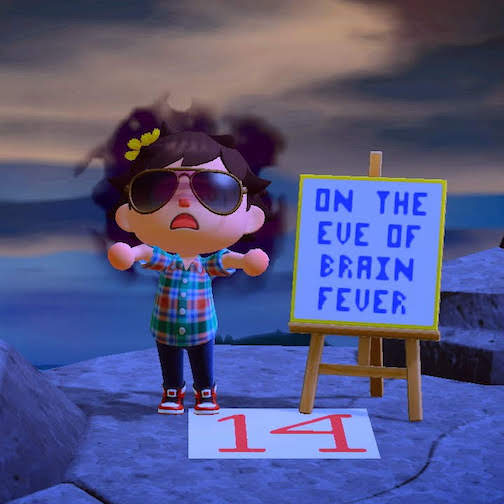
Just what do you think you’re doing, Dave? Anyway, kudos to Garnett and maybe the lot of them for translating “brain fever” upwards of nine times. Nine! “Might easily have fallen ill with brain fever,” “a dangerous attack of brain fever,” “don’t believe him, he has brain fever.” And, of course, three variations of “On the Eve of Brain Fever.” Three! Wonderful. You’re welcome.
41. Kinks – Oklahoma USA
So I read Moby-Dick and The Brothers Karamazov during the pandemic. Big deal. Sam Anderson’s (deep breath) Boom Town: The Fantastical Saga of Oklahoma City, Its Chaotic Founding, Its Apocalyptic Weather, Its Purloined Basketball Team and the Dream of Becoming a World-Class Metropolis was better than both by a non-condensed, non-translated mile and I didn’t even have to default to more Flaming Lips—always there, nonetheless, in our hearts. Best “new” (to me) book I’ve read since Tara Westover’s Educated.
42. Quill – Thumbnail Screwdriver
43. Ford Theatre – I’ve Got the Fever
For a manufactured scene, this Bosstown Sound bullshit has taken over the playlist and the word count. Eleven songs? Forty-seven minutes? Fifteen hundred words? Isn’t this how the Strokes started out? If Earth Opera was one legitimately talented and unique discovery then Quill (who should have capitalized on an excellent Woodstock showing) and Ford Theatre (who shot and killed Abraham Lincoln) were the other two. Quill is my favorite of the bunch and not just because “They Live the Life” and “That’s How I Eat” are included on both of my Woodstock boxed sets. (“That was called ‘Feedback.’”) 1970’s Quill is the genuine article and better than anything Ten Years After, Alvin Lee and Alvin Lee’s flowing locks could ever steal from Elmore James and Sonny Boy Williamson. Ford Theatre, meanwhile, managed two albums before disappearing. Time Changes, their second, is a borderline ridiculous concept album about star-crossed lovers or whatever and includes a song celebrating “Jefferson Airplane,” belying their stated dissociation from any hip flower-power In Crowd. It and the debut Trilogy for the Masses sound great though, if slightly overcooked, and are well worth seeking out. Few bands had their chops or wrote and produced music the way they did… not for another fifteen years, anyway, when Bonnie Tyler borrowed heavily from “Theme for the Masses” for a little number called “Total Eclipse of the Heart.” Turn around! Every now and then I steal some art!
44. The Jim Kweskin Jug Band – You’se a Viper
“Bosstown Sound,” continued. In the grand tradition of “Just Make Love to Me”/“I Just Want to Make Love to You,” this Jazz Age paean to fantastical five-foot reefers was rechristened “If You’re a Viper” long before Jim Kweskin & Friends got their ragtime hands on it. “Light that tea, let it be!” With this trivia out of the way, we’ve arrived at Astral Weeks’s somewhat dark subplot. Take it, Wikipedia!
In the late 1960s, Kweskin joined the Fort Hill Community, which was founded by former Kweskin Jug Band harmonicist Mel Lyman in Boston.
Lyman is remembered in folk music circles for playing a twenty-minute improvisation on the traditional hymn “Rock of Ages” at the end of the 1965 Newport Folk Festival to the riled crowd streaming out after Bob Dylan’s famous appearance with an electric band. Some felt that Lyman, primarily an acoustic musician, was delivering a wordless counterargument to Dylan’s new-found rock direction.
In 1966, Lyman founded and headed the Lyman Family, also known as the Fort Hill Community, centered in a few houses in the Fort Hill section of Roxbury, then a poor neighborhood of Boston. The Fort Hill Community, to observers in the mid to late sixties, combined some of the outward forms of an urban hippie commune with a neo-transcendentalist socio-spiritual structure centered on Lyman, the friends he had attracted and the large body of his music and writings.
According to [two ex-members], a macho, bullying ethic prevailed and guns were frequently brandished. Lyman seemed to believe that one could only be truly creative when one was “real” or “awake”—defined in practice as experiencing intense pain or anger—and that fear and cowardice caused one to remain “asleep” or even to die. People were subjected to rigid discipline and highly structured lives.
“The Manson Family preached peace and love and went around killing people. We don’t preach peace and love. And we haven’t killed anybody—yet.”
In the mid eighties, members of the Fort Hill Community announced that Lyman had died in 1978, age forty. However, the community never presented a death certificate, provided details about how he passed or disclosed what they did with his remains. There was no legal investigation.
After Lyman’s death, the Family evolved into a smaller, more conventional extended family.
Ladies and gentlemen, I present the Trump/MAGA playbook for 2024.
45. The Freeborne – Peak Impressions and Thoughts
“Peak Impressions was released in mid 1967 to moderate success on the east coast. However, it suffered from being associated with the ‘Bosstown Sound,’ a commercial campaign that advertised groups such as Ultimate Spinach, Beacon Street Union and Orpheus with the intention of competing with the San Francisco Sound.” And: scene!
46. John Dwyer – The War Clock ✔️
Fully credited to John Dwyer (appearance number three), Ryan Sawyer, Peter Kerlin, Brad Caulkins, Kyp Malone, Tom Dolas, Marcos Rodriguez, Andres Renteria, Ben Boye, Laena Myers-Ionita and Joce Soubrian. “The War Clock” was my favorite song of 2021—the list is admittedly short—so its Moon-Drenched home base kind of backed into a Creamy®.
| ⚪ | 2021 | John Dwyer – Moon-Drenched |
The busy Dwyer and a rotating lineup of collaborators also released the Witch Egg, Endless Garbage and Gong Splat LPs in an Osees-less year gone mad. What could Ty Segall’s Harmonizer even do? “There was no foul on the play… the defender was just overpowered.”
47. Brainiac – Status: Choke
I’ve been trying to cram this motherfucker onto a mix for over a decade. “Where have my daisies gone?” To the great distorted Korg in the sky: RIP Timmy Taylor, way after the fact.
48. Jungle Brothers – Kool Accordin’ 2 a Jungle Brother
You know what’s worse than starting with a side-one-track-one? Ending with a side-two-last-track. If it’s cool according to kool accordin’ 2 the Jungle Brothers, though, it’s alright with me.
Make it happen, cap’n: we’ve got one song from the fifties; fifteen from the sixties (none before ’65, seven from returning champion ’68); thirteen from the seventies (three from ’75); three from the eighties (you can’t win, Rock!); six from the nineties; three from the aughts (two from ’03); two from the teens; and five from the twenties (though not ’22). Bless you, daughter. Flee with us to foreign lands should America’s casual acceptance of school shootings usher Trump, DeSantis or any other Republican into the White House.
More furious madness
Volume 0 | Volume 1 | Volume 2 | Volume 3 | Volume 4 | Volume 5 | Volume 6 | Volume 7 | Volume 8 | Volume 9 | Volume 10 | Volume 11 | Volume 12 | Volume 13
 More Cream Please